
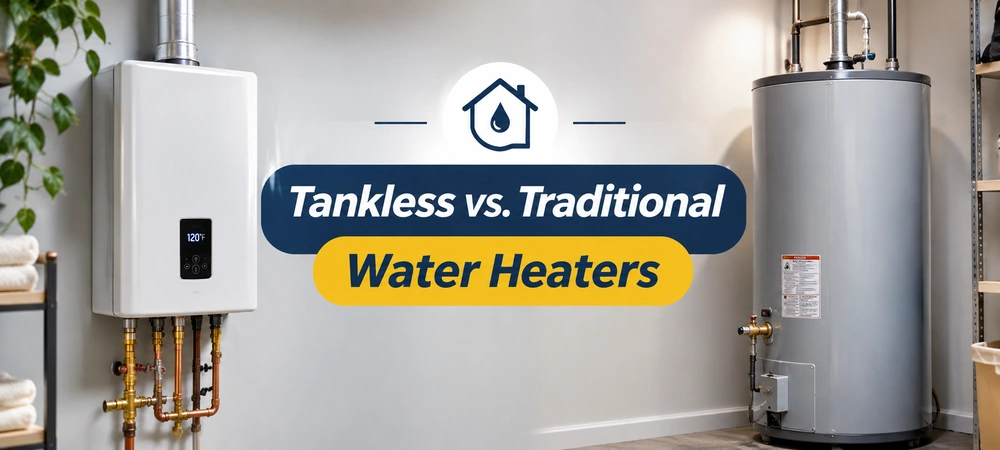
Choosing a new water heater is a decision that affects your home’s comfort, energy use and utility bills for years. If your existing unit is nearing the end of its service life, you may be considering whether to replace it with another traditional storage tank or upgrade to a tankless system. Both options can provide reliable hot water, but they work differently and suit different household needs. In this guide to tankless vs traditional water heater systems, we compare how each type works, their efficiency, hot water capacity, installation requirements, maintenance and long-term costs so you can make an informed decision for your Ontario home.
How Do Tankless and Traditional Water Heaters Work?
The main difference is how each system heats and supplies water. A traditional water heater stores a supply of hot water in an insulated tank, while a tankless water heater heats water as it flows through the unit. Understanding this difference helps explain why their performance, space requirements and energy use can vary.
What Is a Traditional Tank Water Heater?
A traditional water heater heats and stores water in an insulated tank, commonly located in a basement, utility room or mechanical space. Depending on the model, it uses natural gas, propane or electricity to heat the water.
Once the water reaches the thermostat’s set temperature, the heater maintains that temperature by reheating the stored supply when necessary. When someone takes a shower, runs a dishwasher or uses a hot water tap, heated water leaves the tank and incoming cold water enters to replace it.
Traditional water heaters are widely used in Canadian homes because they are familiar, relatively straightforward to install in many existing properties and available in different tank capacities.
What Is a Tankless Water Heater?
A tankless water heater, also called an on-demand water heater, does not store a large supply of hot water. Instead, it heats water as it passes through the unit when a hot water tap or appliance calls for it.
When hot water is requested, the unit activates its heating system and transfers heat to the flowing water. Once the demand stops, the heater stops heating. Because it does not continually maintain a large tank of stored hot water, it avoids much of the standby heat loss associated with storage systems.
Tankless models are generally wall-mounted and take up less floor space than conventional storage tanks. They are available in different capacities, with the appropriate model depending on the number of fixtures and the amount of hot water required at the same time.
Tankless vs Traditional Water Heater: Key Differences
Both systems can be suitable for Canadian homes, but they have different strengths. The following comparison highlights the main factors to consider before choosing one.
| Feature | Tankless Water Heater | Traditional Tank Water Heater |
|---|---|---|
| How it works | Heats water as it flows through the unit | Heats and stores water in a tank |
| Hot water supply | Continuous while demand stays within the unit’s capacity | Limited by the amount of hot water stored and recovery rate |
| Energy use | Avoids most standby heat loss from stored water | Can lose heat while maintaining stored water temperature |
| Space required | Compact, usually wall-mounted | Requires floor or platform space for the tank |
| Installation | May require gas, venting, electrical or plumbing upgrades | Often simpler when replacing a similar existing unit |
| Hot water during peak demand | Limited by flow rate and temperature rise | Limited by tank capacity and recovery rate |
| Maintenance | May require periodic descaling and system inspection | May require tank flushing and component inspection |
| Upfront cost | Often higher, depending on equipment and installation work | Often lower for a straightforward replacement |
One important point: neither system is automatically the right choice for every property. A properly sized tank heater may be more practical for one household, while a correctly specified tankless unit may be a better fit for another.
Energy Efficiency: Which Water Heater Uses Less Energy?
Energy efficiency is one of the main reasons homeowners consider switching to a tankless system. A traditional tank continuously maintains a supply of hot water, even when nobody is using it. Some of the stored heat escapes through the tank and connected pipes, so the heater periodically operates to maintain the set temperature. This is known as standby heat loss.
A tankless system heats water only when there is a demand for hot water. This reduces standby losses and can lower energy consumption, particularly in households with regular but intermittent hot water use.
Can a Tankless Water Heater Reduce Energy Bills?
It can, but actual savings depend on the existing heater, the replacement model, fuel prices, household hot water use and installation conditions. Natural Resources Canada reports that ENERGY STAR certified tankless water heaters use an average of 30% less energy than standard storage tank models. This is an average comparison, not a guaranteed saving for every home.
For a fair comparison, look at the efficiency ratings of the specific models rather than relying only on the equipment type. A high-efficiency storage tank may perform better than an older, inefficient tankless unit.
For Canadian homeowners comparing products, Natural Resources Canada’s ENERGY STAR information for tankless water heaters is a useful starting point.
Hot Water Supply: Which System Is Better for Busy Households?
Hot water availability is often the deciding factor for families. The two systems deliver hot water differently, so the best option depends on how many people live in the home and how many fixtures may operate at the same time.
Tankless Water Heaters and Continuous Hot Water
One of the biggest advantages of a tankless water heater is that it does not run out of stored hot water in the same way a traditional tank does. As long as the unit is operating correctly and demand stays within its rated capacity, it can continue heating incoming water.
However, continuous hot water does not mean unlimited flow. Every tankless unit has a maximum flow rate, usually measured in litres per minute or gallons per minute, and a maximum heating capacity. If several showers, faucets or appliances operate simultaneously, the combined demand may exceed what the unit can heat at the required temperature.
For example, a household that regularly runs two showers while using hot water in the kitchen needs a unit sized for that combined demand. Choosing a model based only on the number of bathrooms can lead to disappointing performance.
Traditional Water Heaters and Stored Hot Water
A traditional tank provides a ready supply of heated water. Its capacity is determined by the size of the tank and how quickly the heater can recover after hot water is used.
Once the stored hot water is depleted, the system needs time to heat the incoming cold water. This can be noticeable when several family members shower one after another or when multiple appliances use hot water at the same time.
A correctly sized tank can still provide reliable performance for many households. Its first-hour rating and recovery rate are useful specifications to review when comparing models.
How Does Ontario’s Winter Weather Affect Water Heater Performance?
Ontario’s cold winters are an important consideration when choosing a water heater. Incoming water is colder during winter than during warmer months in many locations. This means the heater must work harder to raise the water to the desired temperature.
This is particularly relevant for tankless systems because their output depends on both the incoming water temperature and the required hot water flow rate.
Why Incoming Water Temperature Matters for Tankless Systems
Tankless water heaters are rated to deliver a certain flow rate at a specified temperature rise. Temperature rise is the difference between the temperature of incoming cold water and the temperature of the heated water leaving the unit.
For example, if incoming water is colder in winter, the heater must provide a larger temperature rise to deliver water at the same outlet temperature. At a higher temperature rise, the unit may need to reduce its flow rate to maintain the target temperature.
This is why selecting a tankless water heater based on a warm-weather performance figure alone can be misleading for an Ontario property. The system should be sized using realistic winter incoming-water temperatures and the home’s expected simultaneous hot water demand.
Do Traditional Tank Water Heaters Work Well in Canadian Winters?
Traditional storage tanks can also handle Ontario’s winter conditions when properly sized and installed. The tank stores heated water, so the system can supply hot water from that reserve even when several fixtures are used in sequence.
However, colder incoming water can increase the time and energy needed to recover the tank’s temperature after heavy use. Insulating nearby hot water pipes and choosing an appropriate tank capacity can help support performance.
Installation Requirements: What Should Homeowners Expect?
Installation is another major difference between the two systems. Replacing an existing tank with a similar model may be relatively straightforward. Switching from a tank to a tankless unit can involve additional work, depending on the home’s existing gas supply, venting, electrical service and plumbing layout.
Installing a Tankless Water Heater
A tankless installation needs to account for the unit’s heating input and the property’s existing infrastructure. Depending on the model and site conditions, the work may include:
- Gas supply: The gas line must be suitable for the appliance’s required input. An existing line may need to be assessed or upgraded.
- Venting: Gas-fired units require an approved venting arrangement that meets the manufacturer’s instructions and applicable requirements.
- Electrical supply: Many gas tankless models require electricity for controls, ignition and other components. The required electrical connection depends on the model.
- Condensate drainage: High-efficiency condensing models produce condensate that must be drained correctly. A neutralizer may be required depending on the installation and applicable requirements.
- Water connections: The plumbing must be arranged to provide the required flow, isolation and service access.
- Location: The installation area must allow for proper venting, clearances, maintenance access and protection from freezing where relevant.
Some tankless systems also require additional measures in locations where water lines or equipment may be exposed to freezing temperatures. The installation should follow the manufacturer’s instructions and applicable Ontario requirements.
Installing a Traditional Tank Water Heater
A conventional tank replacement may be simpler when the new unit uses the same fuel type and fits the existing location. However, the installation still needs to address safe fuel connections, venting where applicable, plumbing, drainage, temperature and pressure relief protection, and electrical requirements for the selected model.
Tank dimensions and access should also be considered. A replacement unit that is taller or wider than the old one may not fit through the same access route or into the existing mechanical space.
For either system, use a qualified professional who can assess the installation and ensure the work meets applicable Ontario codes, safety requirements and manufacturer specifications.
Maintenance: Which Water Heater Is Easier to Maintain?
Both types of water heaters need regular attention. Maintenance requirements vary by model, water quality, usage and manufacturer recommendations.
Tankless Water Heater Maintenance
Mineral deposits can build up inside a tankless heat exchanger, especially in areas with hard water. Over time, scale can affect heat transfer and restrict water flow.
Depending on the model and local water conditions, maintenance may include:
- Flushing or descaling the heat exchanger at the recommended interval.
- Cleaning inlet water filters and strainers.
- Inspecting the venting system and air intake.
- Checking condensate drainage on condensing models.
- Inspecting gas connections and system operation.
Some homes may benefit from water treatment or filtration if mineral content is contributing to scale buildup. The right approach depends on a water-quality assessment and the equipment manufacturer’s requirements.
Traditional Tank Water Heater Maintenance
Storage tank systems can accumulate sediment over time. Mineral deposits may settle at the bottom of the tank, potentially affecting efficiency and contributing to noise or reduced performance.
Depending on the model and manufacturer instructions, maintenance may include:
- Inspecting the tank, fittings and surrounding area for signs of leakage or corrosion.
- Checking the temperature and pressure relief valve.
- Flushing sediment where the manufacturer recommends it.
- Inspecting the anode rod on applicable tank models.
- Checking the burner, venting or electrical components as applicable.
Do not assume that every water heater needs the same maintenance schedule. Follow the manufacturer’s instructions and have service performed by a qualified professional.
Upfront Cost vs Long-Term Operating Cost
The purchase price is only one part of the cost of owning a water heater. Homeowners should also consider installation, energy use, maintenance and the potential need for upgrades to existing plumbing, gas or electrical systems.
Tankless Water Heater Costs
Tankless systems often have a higher upfront equipment and installation cost than a straightforward replacement of a traditional tank. The final amount depends on the model, heating capacity, fuel type, venting route, gas supply, electrical requirements and plumbing modifications.
For an existing home, installation costs can increase if the gas line needs upgrading or a new venting route is required. These details should be assessed before comparing quotes.
Over time, a high-efficiency tankless model may reduce energy use compared with a standard storage tank. However, the amount saved depends on actual household consumption, the equipment being replaced and local energy rates.
Traditional Water Heater Costs
Traditional tank water heaters often have a lower initial cost, particularly when replacing an existing unit with a similar model. Their installation may require fewer modifications if the current connections and location are suitable.
Operating costs depend on the fuel source, tank insulation, equipment efficiency, thermostat settings and how much hot water the household uses. A less expensive unit to install is not necessarily the least expensive option over its full service life.
What Should You Compare Before Making a Decision?
Ask for a complete quote that identifies the equipment and installation work. Compare:
- Equipment model, fuel type and efficiency rating.
- Expected hot water demand and selected capacity.
- Gas line, venting, electrical and plumbing modifications.
- Required drainage or condensate arrangements.
- Included installation work and applicable permits or inspections.
- Manufacturer warranty and recommended maintenance.
- Estimated operating costs based on your household’s usage and local energy prices.
Natural Resources Canada’s Guide to Residential Water Heaters provides additional information on water heater types, sizing and energy efficiency.
Which Water Heater Is Better for Different Types of Homes?
The right choice depends on the property, hot water usage and installation conditions. Here are some situations where one system may be more suitable than the other.
Small Homes and Condos
A tankless water heater may be attractive where mechanical space is limited. Its compact, wall-mounted design can free up floor space. However, the unit still needs adequate service access and suitable gas, electrical and venting connections.
A traditional tank may be a practical choice where an existing installation already accommodates it and the household’s hot water needs are modest.
Large Families
Families with several bathrooms and overlapping morning routines should pay close attention to peak hot water demand. A properly sized tankless system can provide continuous hot water within its rated capacity, but an undersized model may struggle when multiple showers and appliances operate together.
A larger storage tank may suit households with predictable periods of high demand. Its first-hour rating and recovery rate should be checked against actual usage.
Older Homes in Toronto and the GTA
Older homes may need additional planning before a tankless conversion. Existing gas piping, venting routes, electrical capacity and plumbing arrangements may not be suitable for the selected equipment without modifications.
Before choosing a system, have the installation conditions assessed. A professional can determine whether the existing infrastructure can support the new heater and identify any work needed to complete the installation safely.
New Homes and Renovation Projects
New construction and major renovations offer more flexibility because the water heater location, fuel supply, venting and plumbing can be planned around the selected equipment.
This is a good opportunity to compare tankless and storage systems based on expected occupancy, fixture demand, energy source and available mechanical space rather than simply choosing the same type of heater used in the previous property.
Are Tankless Water Heaters Suitable for Commercial Properties?
Commercial properties often have more complex hot water requirements than residential homes. Restaurants, salons, gyms, clinics, offices and multi-unit buildings can have different demand patterns, operating hours and peak usage periods.
A tankless system may be suitable for some commercial applications, particularly where space is limited or hot water demand varies throughout the day. Multiple units can sometimes be installed in a coordinated arrangement to meet higher demand, subject to proper system design.
Traditional commercial storage systems may be preferable where a property needs a large reserve of hot water for short periods of heavy use. Some facilities may also use a combination of storage and on-demand equipment.
Commercial water heater selection should account for:
- Peak hot water demand and expected flow rates.
- Required water temperature for the building’s use.
- Number of fixtures and appliances operating simultaneously.
- Recovery requirements and operating schedule.
- Fuel availability, venting and mechanical room conditions.
- Redundancy and the consequences of equipment downtime.
- Applicable plumbing, building, gas and safety requirements.
For a commercial property, a site assessment and demand calculation are particularly important. A residential-sized unit should not be selected for a commercial application without confirming that it is approved and suitable for the intended use.
Signs It May Be Time to Replace Your Existing Water Heater
If your water heater is no longer delivering reliable performance, replacement may be worth considering. Watch for these common signs:
- Inconsistent hot water: Water temperature changes unexpectedly or the supply runs out more quickly than before.
- Visible leaks: Water around the base of a tank or near plumbing connections should be investigated promptly.
- Unusual noises: Popping, rumbling or banging sounds can indicate sediment buildup or other equipment issues.
- Rising energy bills: An older or poorly performing unit may use more energy than expected.
- Frequent repairs: Repeated service calls can make replacement worth comparing against continued repairs.
- Age and condition: Older equipment may be closer to the end of its useful service life, although actual lifespan varies by model, water quality, installation and maintenance.
If you notice a gas smell, signs of combustion problems or water leaking near electrical equipment, treat the situation as a safety concern and contact an appropriate qualified professional.
How to Choose the Right Water Heater for Your Property
Before deciding between a tankless and traditional water heater, consider how your property uses hot water rather than choosing based on equipment type alone.
- Assess daily hot water use: Consider the number of occupants, bathrooms, showers, sinks and appliances.
- Identify peak demand: Work out which fixtures are likely to operate at the same time, especially during busy morning and evening periods.
- Check the available fuel source: Confirm whether natural gas, propane or electricity is available and suitable for the selected system.
- Review installation conditions: Assess the existing gas line, electrical supply, venting, drainage, plumbing and available space.
- Compare efficiency ratings: Review the specifications of individual models and compare products designed for similar applications.
- Consider long-term ownership: Include installation, energy use, maintenance and warranty coverage in your decision.
- Get a professional assessment: Have the system sized and the installation requirements checked before purchasing equipment.
Taking these steps can help avoid common problems such as insufficient hot water, unnecessary installation costs or choosing a system that does not suit the property’s demand.
Frequently Asked Questions About Tankless and Traditional Water Heaters
Is a tankless water heater better than a traditional water heater?
Not in every situation. Tankless systems can reduce standby heat loss, save space and provide continuous hot water within their rated capacity. Traditional tanks often have a lower upfront replacement cost and provide a stored supply of hot water. The better option depends on household demand, installation conditions, budget and energy costs.
Does a tankless water heater provide unlimited hot water?
A tankless water heater can continue producing hot water while it operates within its rated capacity. However, it has a maximum flow rate and heating capacity. If several fixtures use more hot water than the unit can heat at the required temperature, flow or outlet temperature may be affected.
Can a tankless water heater handle Canadian winters?
Yes. A properly selected and installed tankless water heater can operate in Ontario homes during winter. The key is sizing the unit for colder incoming water temperatures and the property’s expected hot water demand. The required temperature rise affects the flow rate the unit can deliver.
Does a tankless water heater save money?
It may reduce energy costs compared with a standard storage tank, but savings vary. Equipment efficiency, household hot water use, fuel prices, installation costs and maintenance all affect the financial outcome. Compare the full installed cost and expected operating costs before deciding.
Can I replace my traditional water heater with a tankless model?
In many homes, yes, but it is not always a direct replacement. A tankless conversion may require changes to the gas supply, venting, electrical connection, condensate drainage or plumbing. A qualified professional should assess the existing setup and confirm what modifications are needed.
Do tankless water heaters need regular maintenance?
Yes. Depending on the model and water quality, maintenance may include descaling the heat exchanger, cleaning filters and inspecting venting and condensate drainage. Follow the manufacturer’s recommended service schedule.
Are traditional tank water heaters still a good choice?
Yes. A properly sized and maintained storage tank can provide dependable hot water for many homes. It may be particularly practical when replacing an existing tank where the current installation is suitable and the household’s demand can be met by the selected capacity.
Which water heater is better for a large family?
Either type may work. A tankless system must be sized to handle the family’s simultaneous hot water demand, while a traditional tank must have enough storage capacity and recovery capability. The number of bathrooms alone is not enough to determine the right size.
Can I use a residential tankless water heater for a commercial property?
Only if the specific equipment is approved and sized for the intended application. Commercial buildings may have higher or more concentrated hot water demand and can require commercial-rated equipment or multiple units designed to operate together.
Get Help Choosing the Right Water Heater for Your Ontario Property
Both tankless and traditional water heaters can be reliable options when the equipment is correctly selected, sized and installed. A tankless system may be a good fit if you want to reduce standby heat loss and free up space. A traditional tank may be more practical if you prefer a straightforward replacement and your existing storage capacity meets your needs.
The best choice comes down to your property’s hot water demand, available fuel, installation requirements and long-term operating costs. Jimmy HVAC can help you review the options and identify a suitable water heating solution for your home or commercial property in Toronto and across the GTA.
Explore our tankless water heater options or request a free quote to discuss your project.
0 Comments