
Heat Pump vs. Gas Furnace: Quick Comparison
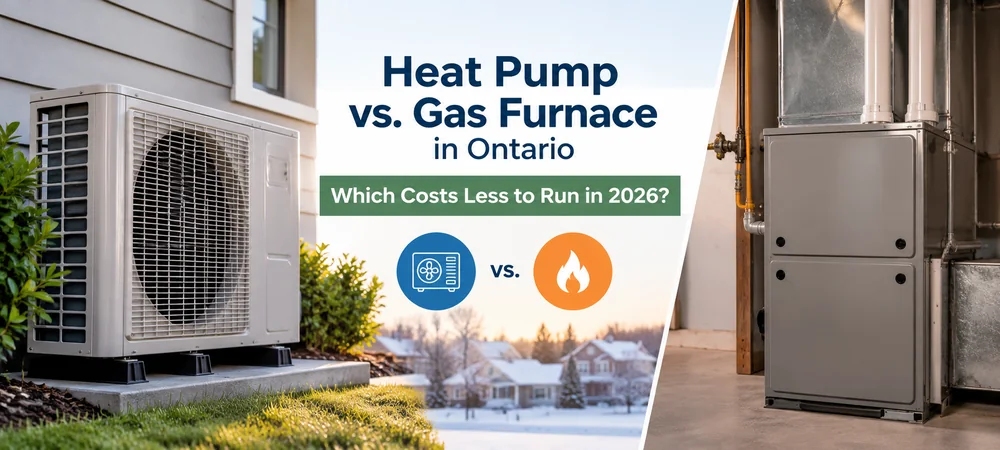
If you are deciding between a heat pump and a natural gas furnace for your Ontario home, one question matters most: which system will cost less to run through the winter?
The answer depends on more than the equipment’s efficiency rating. Electricity prices, natural gas costs, your home’s heating requirements, the performance of the equipment in cold weather, and whether you keep your existing gas connection can all affect your annual energy bills.
For homeowners in Toronto and the Greater Toronto Area (GTA), both systems have advantages. A high-efficiency gas furnace can be economical to operate, while a properly selected cold-climate heat pump can provide efficient heating and air conditioning from one system.
This guide compares heat pumps and gas furnaces using practical examples, explains the factors that influence operating costs, and shows you how to estimate which option could make more financial sense for your home.
Quick answer: Neither system is automatically cheaper for every Ontario home. A heat pump’s running cost depends on its efficiency and your electricity rate, while a gas furnace’s cost depends on its efficiency and the full cost of natural gas. Compare both systems using your own utility rates and expected heating demand before making a decision.
Heat Pump vs. Gas Furnace: Quick Comparison
Before comparing costs, it helps to understand how these systems work and what each one offers.
| Feature | Heat Pump | Gas Furnace |
|---|---|---|
| How it heats | Moves heat from outdoor air into the home | Burns natural gas to generate heat |
| Energy source | Electricity | Natural gas and electricity for system components |
| Winter performance | Efficiency and heating capacity vary with outdoor temperature and equipment design | Provides heat while operating within its rated capacity and fuel supply |
| Air conditioning | Many models provide heating and cooling | Requires a separate air conditioner for cooling |
| Operating costs | Depend on electricity rates, seasonal efficiency, and backup heating | Depend on gas costs, furnace efficiency, and electricity use |
| Installation considerations | May require electrical, ductwork, or other upgrades | Requires suitable gas service, venting, and combustion air arrangements |
| Best comparison | Evaluate heating, cooling, and any backup heating costs together | Evaluate heating costs and include air conditioning if needed |
For homeowners replacing an existing furnace, the most useful comparison is between the full cost of operating each proposed system—not simply the equipment’s advertised efficiency.
How Does a Heat Pump Work Compared With a Gas Furnace?
How a Heat Pump Heats Your Home
A heat pump uses electricity to move heat from one place to another. In winter, an air-source heat pump extracts heat from outdoor air and transfers it indoors. It can continue doing this even when outdoor temperatures are below freezing, although its heating capacity and efficiency generally decrease as the temperature drops.
Because it moves heat rather than generating all the heat through combustion or electric resistance, a heat pump can deliver more thermal energy than the electrical energy it consumes.
Natural Resources Canada explains that heat pumps can be significantly more energy-efficient than conventional heating systems. However, actual performance depends on the equipment, operating conditions, installation, and climate.
Many heat pumps can also reverse their operation in summer to provide air conditioning. This can be an advantage if you are replacing both an older furnace and a separate cooling system.
Explore our ducted heat pump systems to learn how a heat pump can work with a home’s existing forced-air distribution system.
How a Gas Furnace Heats Your Home
A natural gas furnace burns fuel to heat a heat exchanger. A blower then circulates warm air through the home’s ductwork.
Modern high-efficiency furnaces can convert a large proportion of the fuel’s energy into usable heat. Their AFUE rating, or Annual Fuel Utilization Efficiency, indicates how much of the fuel’s energy is converted into heat over a typical heating season.
For example, a furnace rated at 96% AFUE converts approximately 96% of the fuel’s energy into usable heat under the rating conditions. The remaining energy is lost, primarily through the exhaust system.
A furnace does not provide air conditioning by itself. If you want cooling during summer, you will generally need a separate air conditioner or another cooling system.
If you are considering a new gas furnace, explore our furnace options for different heating requirements.
Which Is Cheaper to Run in Ontario in 2026?
The most accurate way to compare a heat pump with a gas furnace is to calculate how much each system costs to deliver the same amount of heat to your home.
Three factors have a major influence on the result:
- Electricity price: The rate you pay for each kilowatt-hour of electricity, including the applicable charges relevant to your calculation.
- Natural gas cost: The cost of gas, including applicable supply and delivery charges, taxes, and other charges that affect your bill.
- System efficiency: The heat pump’s seasonal performance and the furnace’s AFUE rating.
A heat pump may be cheaper to operate when its efficiency offsets the price of electricity. A high-efficiency gas furnace may remain competitive where natural gas is relatively inexpensive.
Natural Resources Canada’s research on cold-climate air-source heat pumps highlights this distinction: operating costs can be comparable to those of conventional gas furnaces in regions with low natural gas prices. The outcome also depends on whether the home retains a gas connection.
Understanding Heat Pump Efficiency: What Does COP Mean?
One important measure of heat pump performance is the Coefficient of Performance, or COP.
COP compares the amount of heat delivered with the amount of electricity consumed at a particular operating condition.
- A COP of 2 means the heat pump delivers 2 kWh of heat for every 1 kWh of electricity consumed.
- A COP of 3 means it delivers 3 kWh of heat for every 1 kWh of electricity consumed.
- A COP of 1 means the heat delivered equals the electricity consumed, as with direct electric resistance heating.
These are examples to explain the calculation, not guaranteed performance figures for a specific heat pump.
Heat pump COP changes with outdoor temperature, indoor conditions, defrost cycles, and equipment operation. A system that achieves a COP of 3 during mild weather may operate at a lower COP during colder conditions.
For annual cost comparisons, seasonal performance is generally more useful than relying on a single COP figure. Ask for performance information that reflects Ontario’s winter conditions and the proposed equipment.
Example: How Much Does a Heat Pump Cost to Run?
Consider a simplified example in which a heat pump needs to deliver 1,000 kWh of heat to a home.
The following table illustrates how electricity consumption changes with different COP values. The electricity prices are illustrative examples, not a statement of the exact rate on your utility bill.
| Heat Pump COP | Electricity Required | Cost at $0.10/kWh | Cost at $0.15/kWh |
|---|---|---|---|
| 1.5 | 667 kWh | $66.70 | $100.05 |
| 2.0 | 500 kWh | $50.00 | $75.00 |
| 3.0 | 333 kWh | $33.30 | $49.95 |
These figures are calculated by dividing the heat required by COP and multiplying the electricity consumed by the assumed electricity price. Values are rounded.
The example shows why efficiency and electricity rates matter. Delivering the same amount of heat costs less when the heat pump operates at a higher COP, assuming the electricity price stays the same.
However, this calculation is not a complete estimate of your annual heating bill. A real comparison must account for seasonal performance, heating demand, backup heating, and the applicable charges on your utility bill.
Example: How Much Does a Gas Furnace Cost to Run?
A gas furnace uses natural gas to produce heat. Its fuel consumption depends on how much heat your home needs and how efficiently the furnace converts fuel into usable heat.
For example, suppose a home requires 1,000 kWh of usable heat and uses a furnace rated at 96% AFUE.
The approximate fuel energy required would be:
1,000 kWh ÷ 0.96 = approximately 1,042 kWh of fuel energy.
This is a simplified energy calculation. To convert the result into a dollar amount, you need the applicable natural gas price and a consistent unit of measurement. Your actual bill may also include delivery charges, customer charges, taxes, and other fees.
For this reason, comparing a heat pump’s electricity-only cost with a gas furnace’s commodity-only cost can produce a misleading result. Use comparable costs and include only charges that are relevant to each scenario.
How to Compare Your Actual Ontario Energy Rates
Ontario homeowners may have different electricity price plans and natural gas rates. Two households with similar heating systems can therefore have different operating costs.
1. Check Your Electricity Price Plan
Ontario residential customers may have access to Time-of-Use, Tiered, or Ultra-Low Overnight electricity pricing, depending on their utility and account.
Under Time-of-Use pricing, the electricity rate changes by time of day. Tiered pricing applies different prices depending on how much electricity is used during the billing period. Ultra-Low Overnight pricing offers a lower overnight rate but has a substantially higher on-peak rate.
These differences can affect heat pump operating costs, especially in a home with significant winter electricity consumption.
Review the current rates and plan details published by the Ontario Energy Board. Your actual electricity bill may also include delivery, regulatory, and other charges, so the advertised energy rate is not necessarily the complete marginal cost of using another kWh.
2. Check Your Natural Gas Charges
Natural gas costs depend on your service area, supply rate, delivery charges, and other applicable bill components.
Check your current gas bill rather than relying on a generic price per cubic metre found online. The Ontario Energy Board publishes regulated natural gas supply rates and explains how rates vary across service areas.
See the Ontario Energy Board’s natural gas rate information for details.
3. Compare the Same Heating Demand
The fairest comparison estimates how much each proposed system would cost to provide the same amount of useful heat over the heating season.
Ask your HVAC contractor to explain the assumptions behind the estimate, including:
- Your home’s estimated annual heating demand.
- The proposed heat pump’s seasonal performance.
- The gas furnace’s AFUE rating.
- Expected use of electric or gas backup heating, if applicable.
- The energy prices and bill charges used in the calculation.
- Whether cooling costs and the existing air conditioner are included in the comparison.
Using the same heating demand prevents one system from appearing cheaper simply because the calculation assumes it delivers less heat.
Does a Heat Pump Still Work During an Ontario Winter?
Yes. Cold-climate air-source heat pumps are designed to provide heating in colder conditions, including below-freezing temperatures.
However, no single outdoor temperature tells the whole story. As outdoor temperatures fall, many heat pumps lose some heating capacity and efficiency. The amount of change varies by model, and some homes may need supplemental heating during the coldest weather.
Natural Resources Canada explains that certain cold-climate heat pumps can operate at outdoor temperatures as low as -30°C. This does not mean every model delivers the same capacity or efficiency at that temperature.
When evaluating a heat pump for a Toronto or GTA home, ask for its heating capacity at relevant low outdoor temperatures—not just its headline efficiency rating.
Also consider whether your home has adequate insulation, suitable ductwork, and enough electrical capacity for the selected equipment and any supplemental heating.
Read more in Natural Resources Canada’s guide to heat pumps and cold-climate performance.
What About a Dual-Fuel Heat Pump and Gas Furnace?
Ontario homeowners do not always have to choose between a heat pump and a gas furnace as completely separate options.
A dual-fuel or hybrid system combines an electric heat pump with a compatible gas furnace. The heat pump provides heating when conditions and operating costs are favourable, while the furnace can provide supplemental heat when needed.
The system’s controls determine when to switch between heating sources. Depending on the equipment and configuration, the changeover may be based on outdoor temperature, heating demand, or an economic balance point.
A hybrid system may be worth considering if you want heat pump cooling and efficient heating during milder weather while retaining gas heating for colder conditions.
However, retaining a gas connection can mean continuing to pay fixed gas charges even when gas consumption decreases. The potential savings therefore depend on the complete utility bill, the control strategy, and the installation cost.
Ask your contractor to compare an all-electric heat pump system with a dual-fuel configuration using the same home’s heating demand and realistic energy prices.
Upfront Cost vs. Annual Operating Cost
The system with the lowest monthly energy cost is not necessarily the least expensive option over its useful life.
When comparing a heat pump with a gas furnace, consider the following costs separately.
| Cost Factor | What to Consider |
|---|---|
| Equipment and installation | Compare itemized quotes for suitably sized systems and the required installation work. |
| Electrical upgrades | Check whether the proposed heat pump or backup heating requires changes to the electrical service or panel. |
| Ductwork changes | Determine whether the existing ducts can accommodate the selected system’s airflow requirements. |
| Annual energy bills | Estimate heating costs using your home’s demand, seasonal efficiency, and current energy prices. |
| Cooling | Account for whether the heat pump replaces an existing air conditioner or whether a separate cooling system is needed. |
| Maintenance and repairs | Consider the expected maintenance requirements and potential repair costs of the proposed equipment. |
| Gas connection | If switching away from gas, determine which fixed charges could be avoided and whether any other gas appliances would remain. |
| Available incentives | Check current official eligibility rules before including a rebate in your financial calculation. |
To estimate long-term value, compare the installation cost plus expected energy and maintenance costs over the same period. Avoid assuming that energy prices, equipment performance, or repair costs will remain unchanged for the entire period.
The Canadian Climate Institute’s research on heat pumps in Canada also highlights how regional energy prices, climate, and building characteristics influence cost competitiveness.
Which System Makes More Sense for Your Home?
The best choice depends on your existing equipment, home, budget, and priorities.
A Heat Pump May Be Worth Considering If:
- You want one system that can provide both heating and cooling.
- Your home is suitable for a properly sized cold-climate heat pump.
- Your electricity rates and the system’s seasonal performance support competitive operating costs.
- You want to reduce your home’s direct use of natural gas.
- You are replacing both an aging furnace and an air conditioner and want to compare the combined cost of alternatives.
A Gas Furnace May Be Worth Considering If:
- Your existing gas furnace is nearing the end of its useful life and you want a straightforward replacement.
- Natural gas remains relatively inexpensive compared with the electricity required by the alternatives.
- Your home has suitable gas service and ductwork.
- Your priority is reliable furnace-based heating and you plan to retain a separate air conditioner.
- The estimated installation and ownership costs are lower for a new high-efficiency furnace.
A Dual-Fuel System May Be Worth Considering If:
- You want a heat pump for heating and cooling during suitable conditions.
- You prefer to retain a gas furnace for supplemental or colder-weather heating.
- You want to compare the flexibility of two heating sources against the additional equipment and operating costs.
These are starting points, not universal rules. A home’s heating load, insulation, existing equipment, and energy rates can change which option offers the best value.
How to Get a More Accurate Cost Estimate
Before replacing your heating system, request an assessment and an itemized quote based on your actual home.
A useful estimate should identify the proposed equipment, its rated efficiency, installation requirements, and any expected electrical or ductwork changes. It should also explain the assumptions used to estimate annual energy costs.
To make the comparison more meaningful, gather the following information:
- Recent utility bills: Collect electricity and natural gas bills that cover a representative heating season.
- Existing equipment details: Record the furnace model, AFUE rating if available, and the age and condition of the cooling system.
- Home characteristics: Note the home’s approximate size, insulation condition, ductwork, and any rooms that are difficult to heat.
- Proposed system details: Request the heat pump model, cold-weather performance information, furnace specifications, and backup heating configuration.
- Itemized installation quotes: Compare equipment, labour, electrical work, ductwork, and other required components.
- Cost assumptions: Ask how the estimated annual energy consumption and energy prices were calculated.
With these details, you can compare the expected operating costs of a heat pump, a gas furnace, or a dual-fuel system without relying on generic savings claims.
How Jimmy HVAC Can Help
If you are considering a new heating system for your home in Toronto or the Greater Toronto Area, Jimmy HVAC can help you explore suitable heating and cooling options.
We can discuss the differences between heat pumps and gas furnaces, help you understand the equipment options available for your home, and arrange an assessment of your heating requirements.
Explore our ducted heat pump systems, learn about our furnace options, or visit our HVAC services page.
Our goal is to help you compare the options based on your home’s needs, installation requirements, and expected operating costs.
Contact Jimmy HVAC to discuss your project and request a quote.
Comparing a heat pump and a gas furnace for your home? Contact Jimmy HVAC to discuss your heating and cooling options in Toronto and the GTA.
Frequently Asked Questions
1. Is a heat pump cheaper to run than a gas furnace in Ontario?
It depends on the heat pump’s seasonal efficiency, your electricity price, the furnace’s AFUE rating, and your natural gas costs. A heat pump can be economical to operate, but a high-efficiency gas furnace may remain competitive where natural gas is relatively inexpensive. Compare both systems using your own utility rates and heating demand.
2. Do heat pumps work in Toronto winters?
Yes. Cold-climate heat pumps are designed to provide heating during cold Canadian winters. Their heating capacity and efficiency vary with outdoor temperature and model, so check the proposed system’s low-temperature performance and whether supplemental heating is needed.
3. Does a heat pump use more electricity in winter?
Heating generally increases a home’s electricity consumption because the heat pump runs to meet the heating demand. How much electricity it uses depends on the home’s heat loss, outdoor temperature, equipment efficiency, thermostat settings, and any supplemental heating.
4. Is a 96% AFUE furnace efficient?
A furnace rated at 96% AFUE converts approximately 96% of its fuel energy into usable heat under the rating conditions. Actual fuel consumption depends on your home’s heating requirements and how the system operates.
5. Can I replace my gas furnace with a heat pump?
Many homes can be suitable for a heat pump, but the right system depends on the home’s heating load, ductwork, electrical capacity, and climate requirements. A qualified HVAC assessment can help determine the appropriate equipment and whether upgrades are needed.
6. Can I keep my gas furnace and add a heat pump?
Yes. A compatible dual-fuel system can combine an electric heat pump with a gas furnace. The controls determine when each heating source operates. The financial benefit depends on equipment costs, energy prices, system settings, and whether you continue paying fixed gas charges.
7. Does a heat pump also provide air conditioning?
Many air-source heat pumps provide both heating and cooling. If you are replacing an existing furnace and air conditioner, compare the cost of a heat pump system with the combined cost of replacing the separate heating and cooling equipment.
8. Will switching to a heat pump eliminate my gas bill?
Not necessarily. If your home still uses natural gas for a water heater, stove, fireplace, or another appliance, you will generally continue to receive a gas bill. Even if you stop using gas for heating, fixed charges may remain while the gas account is active.
9. Are heat pumps more efficient than gas furnaces?
Heat pumps can deliver multiple units of heat per unit of electricity consumed. Gas furnaces convert fuel energy into usable heat, with their efficiency expressed through AFUE. These are different efficiency measures, and a higher efficiency figure alone does not establish which system costs less to operate.
10. Should I choose a heat pump or a gas furnace when replacing an old system?
Compare the upfront installation costs, expected annual energy costs, cooling requirements, and any electrical or ductwork upgrades. The best choice depends on your home and energy prices. An itemized quote and a realistic operating-cost estimate can help you make an informed decision.
Final Thoughts: Compare the Costs Before You Choose
For Ontario homeowners, the choice between a heat pump and a gas furnace is not simply a question of which system is more efficient. It is a question of how much each system will cost to install and operate in your particular home.
A heat pump can provide efficient heating and cooling, while a high-efficiency gas furnace can remain a competitive option where natural gas costs are low. A dual-fuel system may also be worth evaluating if you want to combine both technologies.
Before making a decision, compare the same heating demand, use your actual utility rates, account for seasonal performance, and include installation and ongoing costs. This gives you a more reliable basis for choosing a system than a generic savings estimate.
Planning a heating system upgrade in Toronto or the GTA? Contact Jimmy HVAC to discuss your options and request a quote.
0 Comments